Anthropogenic climate forcing
Anthropogenic climate change is a tug-of-war with fossil fuels playing both sides of the field. Fossil fuel use emits both climate-warming greenhouse gases and climate-cooling aerosols. The impact of anthropogenic aerosols on clouds is the most uncertain driver of climate change. If the poorly-quantified aerosol cooling has thus far masked a large part of well-quantified greenhouse gas warming, then Earth’s climate would be highly sensitive to anthropogenic forcing. The general aim of our research is to better constrain aerosol forcing to enable more reliable projections of climate futures, informing climate change mitigation and adaptation.
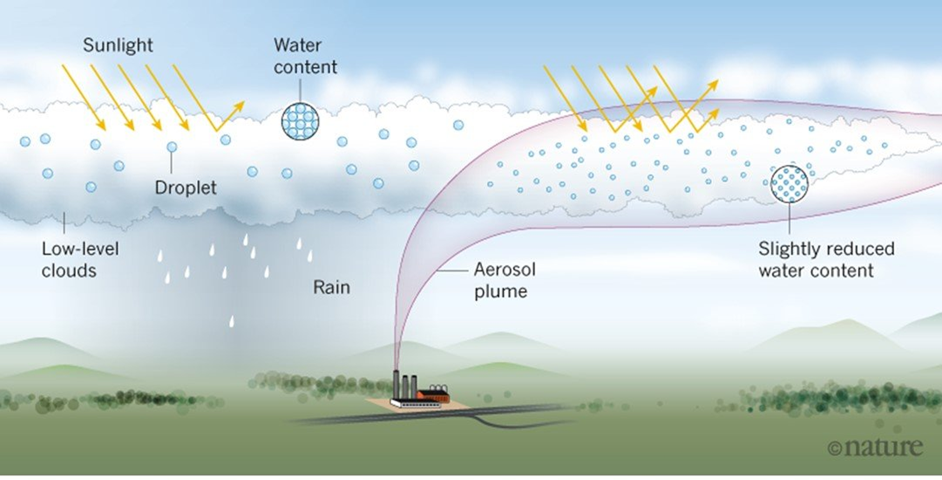
We improve the understanding of aerosol-cloud interactions using plume-shaped polluted cloud track opportunistic experiments. Toll et al 2019 Nature
Aerosols
We improve the understanding of aerosol-cloud interactions using plume-shaped polluted cloud track opportunistic experiments, where experiment-like conditions occur without any intervention by the researcher. We rely on remote sensing of clouds and precipitation to study aerosol impacts on clouds. To what extent are clouds more extensive, thicker and brighter in response to anthropogenic aerosol pollution? Answering these questions helps to solve one of the greatest puzzles in climate science.
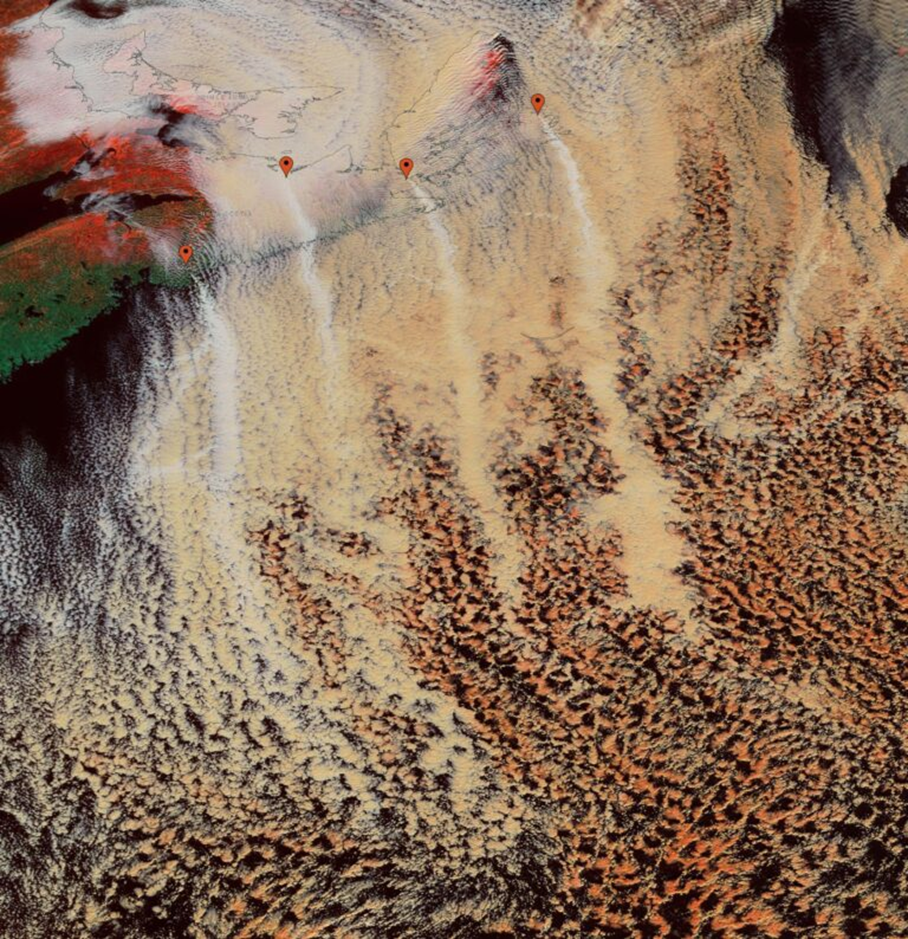
Aerosol-polluted cloud tracks: the cloud tracks polluted by industrial aerosols are given in grey and unpolluted clouds in brownish colours. The industrial aerosol sources inducing the polluted cloud tracks are indicated with place markers.