Climate Change Education
Climate change affects the natural environment around us and human society. Coping with and mitigating climate change begins with climate awareness: understanding the causes of global warming and knowing how to reduce greenhouse gas emissions in everyday life and prepare for climate change. The Climate Research Centre considers it essential to link knowledge creation and sharing, being Estonia’s climate research centre that provides the best information related to climate and climate change.
Raising Climate Awareness in Society
Raising Climate Awareness in Society
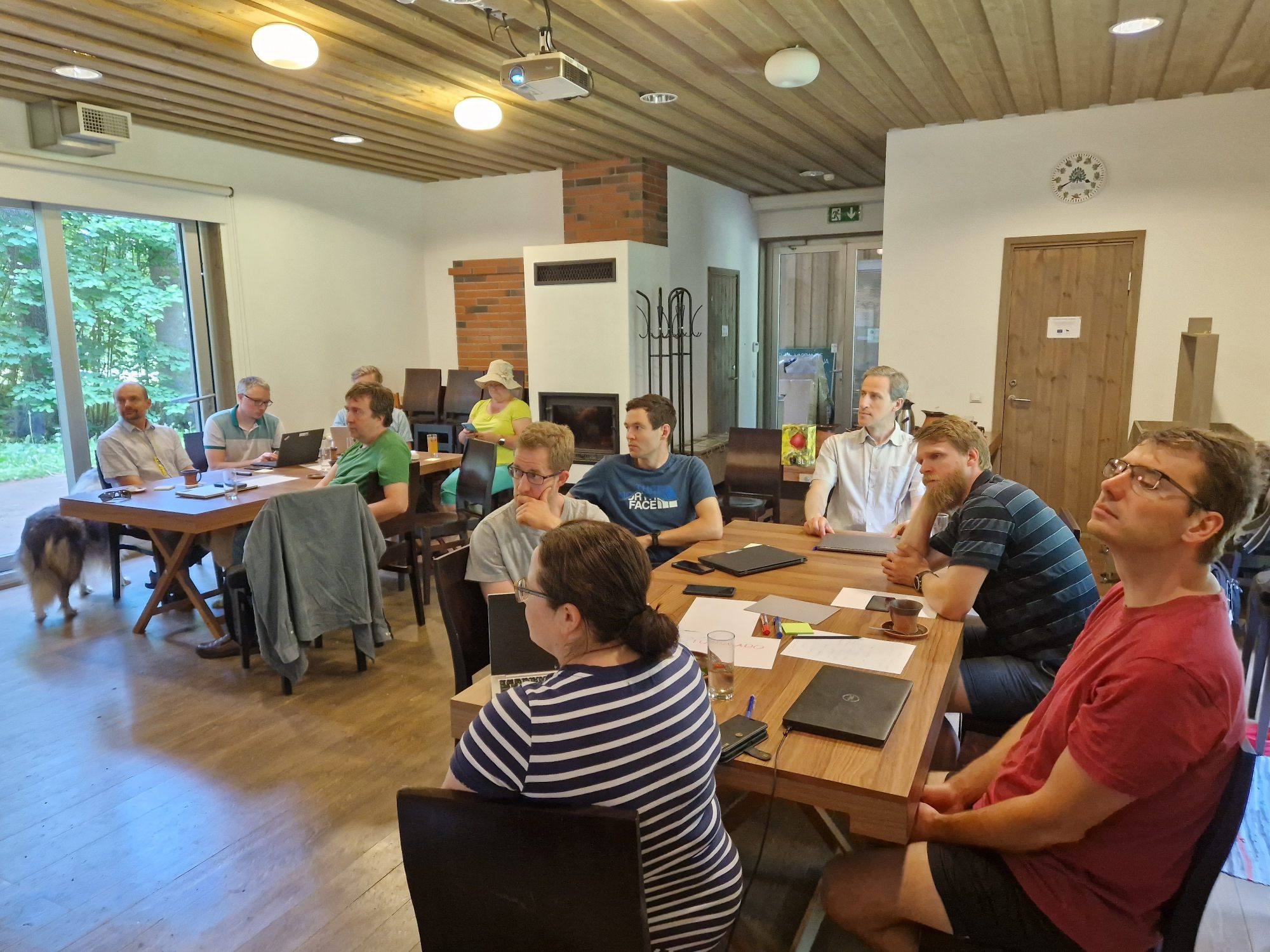
The project “Climate Awareness from School to Society: Empowering Children, Youth, and Teachers to Reduce the Impacts of Climate Change” raised climate awareness in Estonian society through the development of systematic and science-based climate education at all levels of education to support climate change mitigation and adaptation.
The teaching materials created during the project can be found at https://kliimatarkused.ut.ee/.The most comprehensive of these is the teaching material “The ABC of Climate Change,” compiled by researchers from our center in collaboration with other Estonian researchers. It is intended for all teachers and older schoolchildren, but is also suitable for anyone interested in obtaining reliable information about climate change based on the latest scientific findings. https://kliimatarkused.ut.ee/kliimamuutuste-abc/
((koolidele ja üldsusele mõeldud e-õppematerjalid, interaktiivsed kursused ja mängulised lahendused)
(blogid, podcastid, artiklid ja sotsiaalmeedia kaudu levitatav teaduspõhine info kliimamuutuste kohta.) SIIA LISAME LINGID
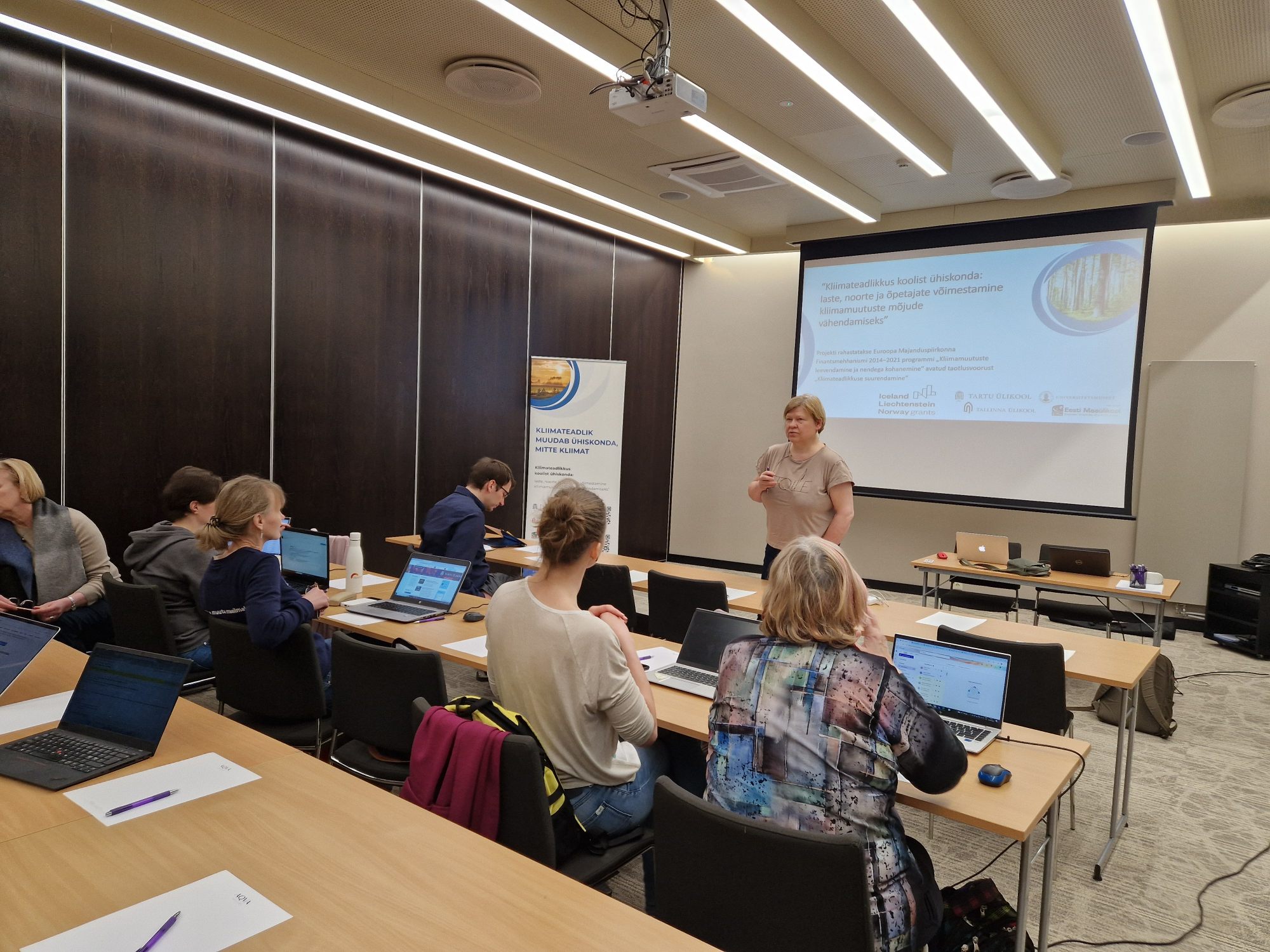
Courses offered by our center at the University of Tartu
We support university education by contributing to the curricula of various faculties at the University of Tartu through courses and seminars on climate change that combine natural sciences, social sciences, and technological solutions.
Subjects we offer
Guide to Climate Science and Policy (3 ECTS)
Meteorology Practicum (3 ECTS)
Physical Fundamentals of Environmental Monitoring (3 ECTS)
Air Pollution Monitoring Management (3 ECTS)
Basics of Environmental Physics I (3 ECTS)
Basics of Environmental Physics II (3 ECTS)
Applied Hydrodynamics (3 ECTS)
Marine Physics (3 ECTS)
Environmental Physics Project (3 ECTS)
Advanced Atmospheric Sciences (5 ECTS)
Processing of Measurement Results (3 ECTS)
Thesis topics
Refining the Impact of Human Activity on Climate
We have discovered an entirely new physical mechanism showing how, in addition to greenhouse gases, human activity warms the Earth’s climate (Figure A). The project investigates observational evidence of how human-made aerosol particles cause cloud droplets to freeze into ice and snow. Freezing reduces the number of clouds and thus contributes to warming the Earth’s climate. The data comes from satellite observations and is analyzed using Python in the supercomputing environment at the University of Tartu.
This work helps better understand a previously poorly understood component of human-induced climate impact: the effect of aerosol particles on cloud freezing (Toll et al. 2024; DOI: 10.1126/science.adl0303). The broader goal is to refine the strength of human climate impact to enable more reliable future climate predictions than currently possible.
About the project in media
- https://novaator.err.ee/1609521331/ohusaaste-tekitab-lund-ja-vahendab-pilvede-hulka
- https://novaator.err.ee/1609521331/ohusaaste-tekitab-lund-ja-vahendab-pilvede-hulka
- https://www.washingtonpost.com/climate-environment/2024/11/14/industrial-pollution-ice-altering-clouds-snow/?fbclid=IwY2xjawMiCUdleHRuA2FlbQIxMAABHqdGrOa0kIZIJAdsEzrOj-bwbHcWARPWw8YK_Dp9zO0JYkW0YV-XbUuUr_b6_aem_iLHa4Ov_eYL3FYFmfEwZrQ
- https://www.washingtonpost.com/climate-environment/2024/11/14/industrial-pollution-ice-altering-clouds-snow/
- https://www.newscientist.com/article/2456202-plumes-of-pollution-from-big-factories-can-make-it-snow/
- https://www.newscientist.com/article/2456202-plumes-of-pollution-from-big-factories-can-make-it-snow/
Suitable for both bachelor’s and master’s theses. Supervisor: Velle Toll velle.toll@ut.ee
The effect of aerosols on clouds in heavily polluted industrial regions: detection of polluted clouds from satellite images
Human activity affects cloud properties and, through them, the global climate. Unfortunately, the impact of human activity on clouds has not yet been accurately determined. Comparing the properties of polluted and unpolluted clouds using satellite measurements creates new opportunities to better quantify the climate impact of human activity. This work applies various image processing methods to distinguish between polluted and unpolluted clouds from satellite images. The success of image processing methods of varying complexity in detecting polluted clouds is compared, and the differences in the optical properties of detected polluted and unpolluted clouds are calculated. Programming skills will be developed during the project. The topic serves as a good introduction to the field of modern satellite measurements and climate change.
The project in public media
https://phys.org/news/2019-08-pollution-wont-global-spike.html
https://novaator.err.ee/965947/ohusaastatuse-vahendamine-ei-hoogusta-gl…
https://novaator.err.ee/1608354707/inimtekkeline-saaste-vahendas-uleilm…
Suitable for both Bachelor’s and Master’s thesis. Supervisor: Velle Toll velle.toll@ut.ee
Fine particles in Estonia’s air in February 2025
Correction of the vertical profile of radar reflectivity
With a meteorological C-band radar, it is possible to measure precipitation amounts with high temporal and spatial resolution. However, its accuracy varies significantly under different conditions. One source of this variability is the different phases of precipitation, which greatly affect the radar signal’s reflectivity. Typically, at our latitude and in every season, precipitation is in solid form at higher altitudes, which means low reflectivity for the radar. During warmer periods, a layer appears where solid particles begin to melt, causing a sudden increase in reflectivity. The aim of this thesis is to test and analyze various open-source vertical profile correction algorithms and their parameters based on multiple case studies. The data used will be the operational data from the Estonian Environment Agency’s Harku and Sürgavere radars from 2010 onwards. One comparison baseline will be the comparison of radar-based precipitation totals with ground-based weather station measurements. At least three of the following methods should be compared:
https://docs.wradlib.org/en/latest/vpr.html
https://pyartmch.readthedocs.io/en/latest/generated/pyart.correct.corr…;
https://pyartmch.readthedocs.io/en/latest/generated/pyart.correct.corr…
Suitable for both Bachelor’s and Master’s thesis. Supervisors: Tanel Voormansik tanel.voormansik@ut.ee and Jorma Rahu jorma.rahu@ut.ee
Estimation of precipitation amounts from radar during the winter period
Creation of a PseudoCAPPI product from raw radar data
A meteorological radar with a parabolic antenna measures reflections by scanning the atmosphere at different elevation angles (a scan at a single elevation angle is called a PPI). Since this data field varies in height depending on the distance from the radar, the nature of the reflections also differs. For example, at low elevation angles near the radar, there are often many ground echoes. Therefore, many applications require a radar product that shows reflectivity at a constant height (or at the closest possible height, since it is not feasible to scan the entire atmosphere uniformly this way). The goal of this thesis is to develop a high-quality and computationally efficient method for calculating PseudoCAPPI that can be used in operational applications. The method can be based on publicly available open-source solutions such as https://fmidev.github.io/rack/productspage.html https://docs.wradlib.org/en/latest/generated/wradlib.vpr.PseudoCAPPI.ht…
An example of the PseudoCAPPI generation principle.
Suitable for both Bachelor’s and Master’s thesis. Supervisors: Tanel Voormansik tanel.voormansik@ut.ee and Jorma Rahu jorma.rahu@ut.ee
Description of Estonia’s past climate based on observational data
New future climate projections for Estonia
Defended Theses
Defended doctoral theses since 2015
1. Novel insights into aerosol-cloud interactions by analysing the temporal evolution of strong anthropogenic cloud perturbations
Jorma Rahu. Tartu, 2025. 85 p.
2. Long-term datasets of dual-polarisation weather radar help detect and nowcast convective storms, including extreme precipitation, lightning, and hail
Tanel Voormansik. Tartu, 2023. 124 p.
3. Polluted clouds at air pollution hot spots help to better understand anthropogenic impacts on Earth’s climate
Heido Trofimov. Tartu, 2022. 96 p.
4. Dependence of UV radiation on climate factors. Reconstruction of UV doses in Estonia for past years
Margit Aun. Tartu, 2017. 124 p.
5. Direct radiative impacts of atmospheric aerosols on meteorological conditions over Europe
Velle Toll. Tartu, 2016. 148 p.
6. Development of Broadband Aerosol Optical Depth Models
Martin Kannel. Tartu, 2016. 168 p.
7. Estimating methods and variability of atmospheric humidity over the Baltic Region and the Arctic
Hannes Keernik. Tartu, 2015. 105 p.
Defended master's theses since 2015
2. The impact of anthropogenic aerosols on clouds at industrial air pollution hot spots: polluted cloud tracks Syed Abbas Ali Zaidi. 2024. Estonian University of Life Sciences.
3. Short-duration precipitation extremes in Estonia Indrek Kaarel Romet. 2024. Estonian University of Life Sciences.
4. Rural background air quality in Estonia during Covid-19 restrictions Ameke Ameke Okoroafor. 2024. Estonian University of Life Sciences.
5. Impact of COVID-19 restrictions on outdoor air quality in Estonia and Latvia, a comparative study Abimbola Opakunle. 2024. Estonian University of Life Sciences.
6. Standardizing Estonian technical vocabulary using the climate field as an example Mariliis Kolk. 2023. Estonian University of Life Sciences.
7. Dynamics of N2O concentrations in the stratosphere based on Aura satellite data Silver Põlgaste. 2023. University of Tartu.
8. Polluted clouds at air pollution hot spots help to better understand anthropogenic impacts on Earth’s climate Heido Trofimov. 2022. University of Tartu.
9. The impact of large-scale atmospheric circulation on seasonal shifts in the Baltic Sea region Sulev Tõkke. 2021. University of Tartu.
10. Climate of short-term precipitation extremes in Estonia Saara-Liis Lutsar. 2021. University of Tartu.
11. Using the optical flow method to improve the temporal resolution of radar observations Jorma Rahu. 2018. University of Tartu.
12. Sentinel-2/MSI applications for European Union Water Framework Directive reporting purposes Ave Ansper. 2018. University of Tartu.
13. Validation of longwave radiation data from major atmospheric reanalysis models in the Baltic Sea region Annika Velt. 2018. University of Tartu.
14. NO2 and SO2 concentrations in outdoor air in the city of Otepää Terje Tammekivi. 2018. Tallinn University of Technology.
15. Application of a terrestrial vegetation primary production model based on radiation use efficiency in Python Mattias Rennel. 2017. University of Tartu.
16. Analysis of suitable seasons for optical remote sensing of land surface and water bodies in Estonia based on METEOSAT satellite cloud data Maanus Kullamaa. 2015. University of Tartu.
17. Recurrence periods of precipitation extremes in Estonia Jüri Kamenik. 2015. University of Tartu.
We Support Science-Based Politics
We train policymakers and organize public lectures and discussions to raise awareness about climate policy and promote science-based public dialogue for developing more effective solutions.
Training for policymakers (seminars aimed at officials and decision-makers to raise awareness of climate policy and support the development of more effective solutions)
Public lectures and discussions (societal debates and dialogues involving scientists, journalists, and activists)
