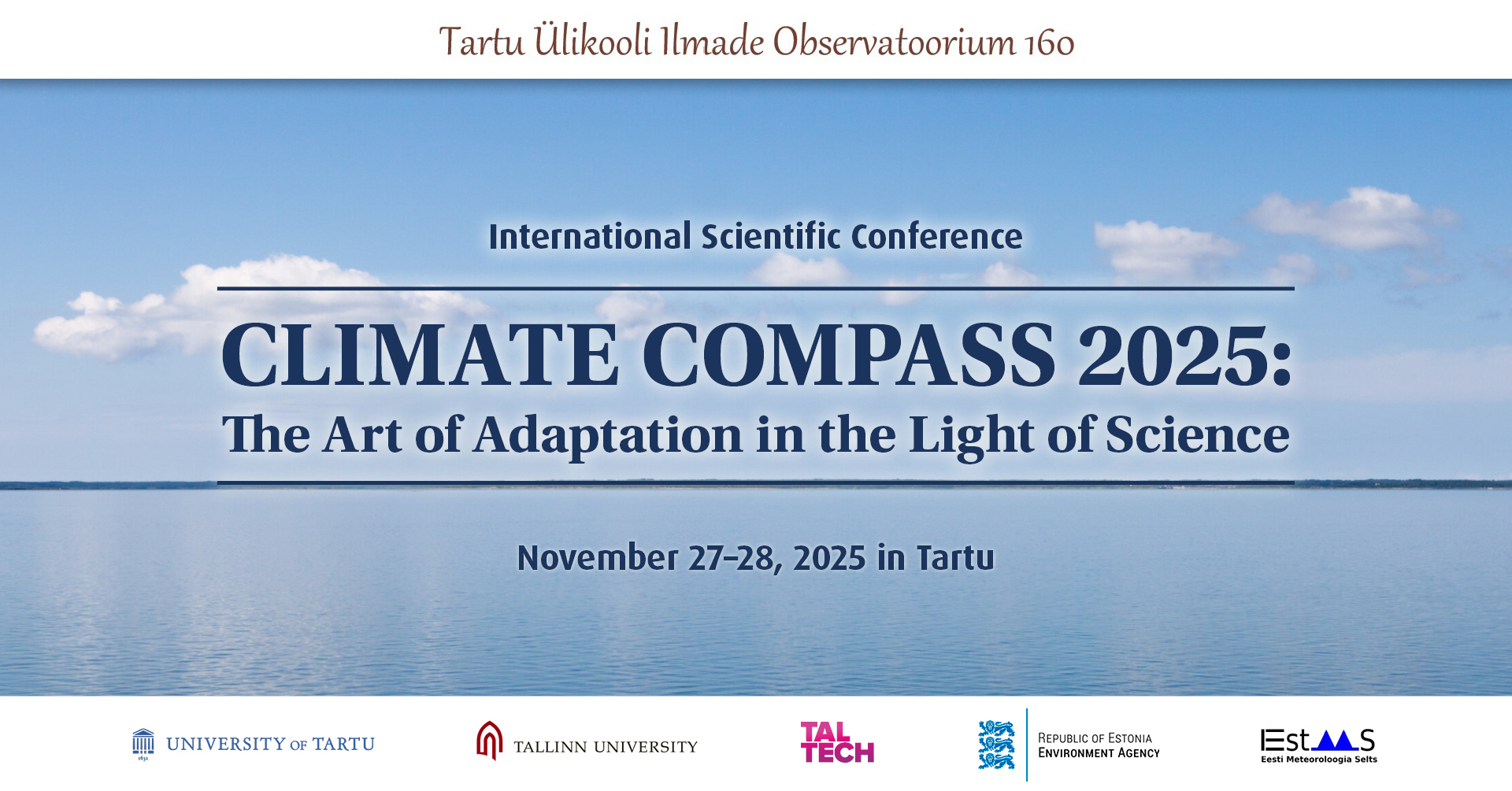
Welcome to the scientific conference Climate Compass 2025
The conference “Climate Compass 2025: The Art of Adaptation in the Light of Science” will take place in Tartu on 27–28 November 2025, marking 160 years since the beginning of systematic weather observations in Estonia. The event brings together researchers, decision-makers, practitioners, and interested participants to discuss the causes and impacts of climate change, as well as strategies for adaptation. The latest scientific findings will be presented, followed by a joint debate on the key development needs.
The first day of the conference, focusing on the global climate picture, will be held in English and feature several internationally renowned scientists. Topics will range from the causes and current state of climate change to sustainable solutions that support adaptation. The second day, held in Estonian, will focus on Estonia’s specific climate adaptation needs. Discussions will include societal impacts, crisis management, sustainable spatial planning, and the history of climate research in Estonia.
Organisers: University of Tartu, Tallinn University, TalTech, Estonian Environment Agency, Estonian Meteorological Society.
Important dates and information
- Abstract submission deadline: 20 October 2025
- Registration deadline: 20 November 2025
- Final programme available: 20 November 2025
- There is no registration fee for speakers or participants
- Contact:
tiia.lillemaa@ut.ee
Both days of the conference will be webcast live on UTTV:
Programme
27 November
University of Tartu Library, Main conference room, W. Struve 1, Tartu
09.30 – 10.00 Registration and welcome coffee
10.00 – 10.30 Opening of the conference
10.30 - 12.00 Session: Drivers of Climate Change
Session chair: Velle Toll
10.30 From Global Data to Science and Decision-Making. Véronique Bouchet (World Meteorological Organisation, Science and Innovation Department)
11.00 Direct observational evidence for a substantial aerosol cooling effect on Earth’s climate. Hannes Keernik, Andres Luhamaa, Margit Aun, Velle Toll (University of Tartu).
11.15 Storyline Simulations of the Extreme Spring 2024 Baltic Sea Marine Heatwave under Climate-Change Conditions. Ilja Maljutenko, Rivo Uiboupin, Shakti Singh (TalTech)
11.30 For the only planet we have. Markku Kulmala (Helsinki University)
12.00 – 13.00 Lunch
13.00 - 14.30 Session: Baltic Sea region in changing climate
Session chair: Germo Väli
13.00 Impact of past climate change on the Baltic Sea. Markus Meier (Leibniz Institute for Baltic Sea Research Warnemuende, Rostock, Germany)
13.30 Spatio-temporal changes in the future of extreme water levels in the Baltic Sea. Katri Viigand, Tarmo Soomere (TalTech)
13.45 Recent Unprecedented Deoxygenation of the Central Baltic Sea. Taavi Liblik (TalTech)
14.00 Evaluating Future Baltic Sea Ecosystem Services Using Climate Change Projections. Mariliis Kõuts, Ilja Maljutenko, Rivo Uiboupin (Tallinna Tehnikaülikooli Meresüsteemide Instituut)
14.15 Cop4ESTCoast – Variability of Estonia’s Coastal Water Quality Indicators Over Time.
Mirjam Uusõue, Kersti Kangro, Krista Alikas, Oleksandr Borysenko (University of Tartu)
14.30 – 15.00 Refreshments break
15.00 - 16.30 Session: Biosphere and Climate: Sustainable Solutions
Session chair: Jaanus Terasmaa
15.00 Potential of water table regulation methods in impact mitigation on drained peatlands.
Bjorn Klove, University of Oulu
15.30 Role of aerosols and their gaseous precursors in the climate system. Heikki Junninen (University of Tartu)
15.45 First decade of SMEAR Estonia: What can we say on climate-driven changes in the forest ecosystem – atmosphere continuum? Steffen Noe (Estonian University of Life Sciences), Emilio Graciliano Ferreira Mercuri (Federal University of Paraná), Joonas Kollo (Estonian University of Life Sciences), Alisa Krasnova (University of Tartu), Dmitrii Krasnov (Estonian University of Life Sciences), Allar Padari (Estonian University of Life Sciences), Ahto Kangur (Estonian University of Life Sciences)
16.00 The Role of Plant Stress Volatiles in Biosphere-Atmosphere System. Ülo Niinemets (Estonian University of Life Sciences)
16.15 Nature’s Role in Climate Change Mitigation and Adaptation. Aveliina Helm (University of Tartu)
16.30 Public attitudes towards nature-based solutions: reflections from four European countries. Ahmed Rezk, Hans Orru, Kati Orru (University of Tartu)
17.00 A historical walk through meteorological landmarks in Tartu
19.00 – 23.00 Conference dinner (a fee of 47 EUR per person upon registration)
28 November (Estonian only)
Speakers

Dr Véronique Bouchet
Dr Véronique Bouchet is the Senior Director for Science and Innovation at the World Meteorological Organization (WMO), where she leads major global research and innovation programmes, including WWRP, GAW and the World Climate Research Programme. Before joining WMO in 2025, she served as Director General of the Canadian Centre for Meteorological and Environmental Prediction. With a PhD in atmospheric modelling, she has an extensive background in developing numerical prediction and air-quality forecasting systems. Dr Bouchet has long contributed to international scientific cooperation, including serving on the WMO Research Board and chairing several expert groups on exascale computing, data infrastructure and the use of AI in numerical weather prediction.

Markku Kulmala
Markku Kulmala is a member of the Academy of Finland, director of the Institute for Atmospheric and Earth System Research (INAR), head of the division of Atmospheric Sciences and Laboratory of Aerosol and Environmental Physics, University of Helsinki. His research focuses on atmospheric aerosols, climate processes, and air quality.

Ülo Niinemets
Ülo Niinemets is a member of the Estonian Academy of Sciences, a professor at the Estonian University of Life Sciences, and the head of the department of Crop Science and Plant Biology. His recent work focuses on plant stress tolerance and adaptability under changing climate conditions.

Markus Meier
Markus Meier is head of the department of Physical Oceanography at the Leibniz Institute for Baltic Sea Research Warnemünde (IOW) and a professor of Physical Oceanography at the University of Rostock. He also chairs the Science Steering Group of the international Baltic Earth network and serves as a Co-Chair of the HELCOM-Baltic Earth Expert Network on Climate Change. His research focuses on regional climate and environmental studies.

Aveliina Helm
Aveliina Helm is the Chair of the European Chapter of the Society for Ecological Restoration (SER Europe), an expert for IPBES – the Intergovernmental Science-Policy Platform on Biodiversity and Ecosystem Services under the UN – and a Professor of Restoration Ecology at the University of Tartu. Her research focuses on the relationships between biodiversity and ecosystem functioning, and their connections to climate change.

Bjørn Kløve
Bjørn Kløve is the head of the Finnish national research flagship Digital Waters (DIWA) and its PhD pilot program and is a professor at the University of Oulu, head of the Water Resources Engineering unit. His research focuses on sustainable water management under climate change conditions.
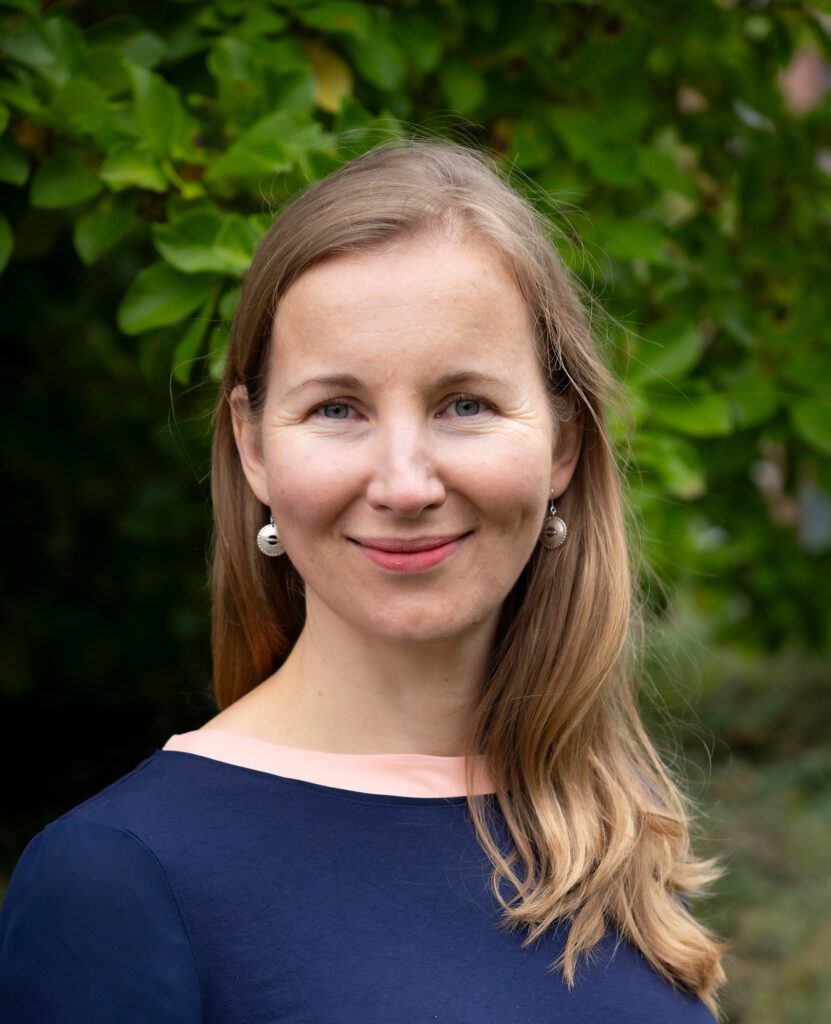
Kati Orru
Kati Orru is a professor in Sociology of Risk and Resilience at the Institute of Social Studies, University of Tartu. Her research focuses on resilience and societal vulnerability.

Erki Tammiksaar
Erki Tammiksaar is an associate professor at the Institute of Ecology and Earth Sciences at the University of Tartu and Head of the Centre for the History of Science at the Estonian University of Life Sciences. His research focuses on the history of natural sciences in Europe, Russia, and Estonia during the 19th and 20th centuries.
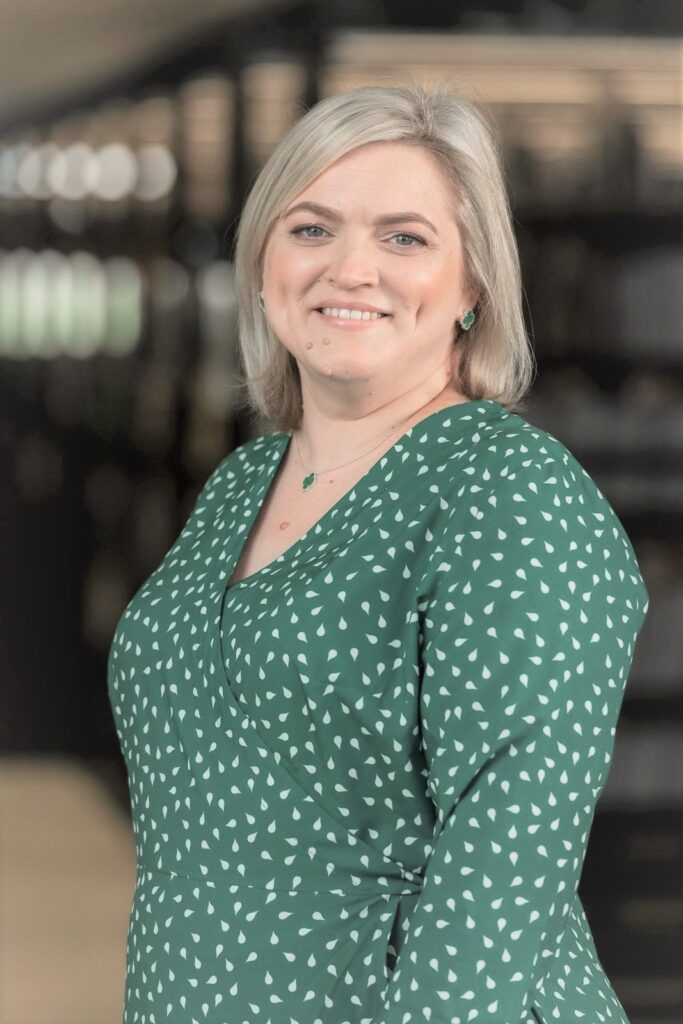
Anna Volkova
Anna Volkova is a professor of Thermal Engineering at Tallinn University of Technology. Her research focuses on sustainable and smart district heating and cooling systems.

Taavi Liblik
Taavi Liblik is a senior researcher at the department of Marine Systems at Teltech and the head of the Marine Physics working group. He is a steering group member of the international Baltic Earth network and the Baltic Operational Oceanographic System (BOOS). His research focuses on processes occurring in the water column of the Baltic Sea.

Hannes Keernik
Hannes Keernik is an associate professor of climate physics at the University of Tartu Centre for Climate Research. His research focuses on aerosol–cloud interactions, Estonian climate analysis, and atmospheric humidity retrievals from remote sensing.
Registration
Please register to the conference here: https://indico.global/event/15023/registrations/
Registration is open until November 20th, 2025

Presentations
We welcome presentations on following topics:
- The physical foundations of climate change
- Climate change in Northern Europe and globally
- Climate change adaptation: methods and strategies
- The history of climate research
- Climate education, communication, and behavioural changes
- You are also welcome to propose your own topic
Format of presentation
The oral presentation length
including questions is 15 minutes.
The recommended poster format
is portrait, size A0.
The posters will be displayed on the second day of the conference, on 28 November 2025 in Physicum. 2025.
Submission instructions
Deadline of Call for abstracts: 20 October 2025
Submission instructions
Deadline of Call for abstracts: 20 October 2025
Format: online submission on Indico platform
Language: Estonian or English
Submission address: https://indico.global/event/15023/abstracts/
You need to login as a user or create an account on Indico platform for submission.
Abstract template
Title:
Author(s) (affiliation(s), email):
Language: (Estonian/English)
Abstract content (max 300 words):
Keywords (3-5):
Review process
The conference scientific committee will review all abstracts. Evaluation criteria are relevance of the topic, originality, practical impact, methodological rigour, and clarity. The scientific committee may request a change in the presentation format (e.g. from oral presentation to poster).

Conference Scientific Committee
Piia Post (University of Tartu, Institute of Physics)
Velle Toll (University of Tartu, Institute of Physics)
Germo Väli (TalTech, Department of Marine Systems)
Jaanus Terasmaa (Tallinn University, School of Natural Sciences and Health)
Heidi-Elisabet Soosalu (Estonian Geological Survey)
Artu Ellmann (TalTech, Department of Civil Engineering and Architecture)
Kati Orru (University of Tartu, Institute of Social Studies)
Ken Ird (University of Tartu Museum)
Heikki Junninen (University of Tartu, Institute of Physics)
Kai Rosin (Estonian Environment Agency)
Supporters
The conference has been supported by the following projects:
AdaptEST – Implementation of national climate change adaptation activities in Estonia (Implementation of national climate change adaptation activities in Estonia, LIFE21-IPC-EE-LIFE-SIP AdaptEst/101069566), which is funded by the European Union’s LIFE program for co-financing environmental projects in member states and by the Estonian state from the proceeds of greenhouse gas emission allowance trading. Neither the European Union nor the funding agencies are responsible for the accuracy of the information in the study or the use of its content.
KIPPER – Climate and Weather Service Prototypes for Sustainable Agriculture in Estonian Regions. ESF co-financed program “Increasing the capacity of society to apply the results of research, development and innovation activities and creating a favorable policy environment for this” (RITA+) 2023–2029 sub-activity 1, which supports the commissioning and implementation of interdisciplinary applied research on cross-cutting issues in the areas of responsibility of ministries related to smart specialisation areas. Co-financiers are the Ministry of Regional Affairs and Agriculture and the Ministry of Climate.
OWGRE – Optimized weather-related green energy production and consumption, funded by ERA-Net Smart Energy Systems (www.eranet-smartenergysystems.eu) and Mission Innovation (mission-innovation.net) partners through a joint project competition in 2019. The project was funded by the European Union’s Horizon 2020 research and innovation program under grant agreements No. 775970 and No. 883973.


